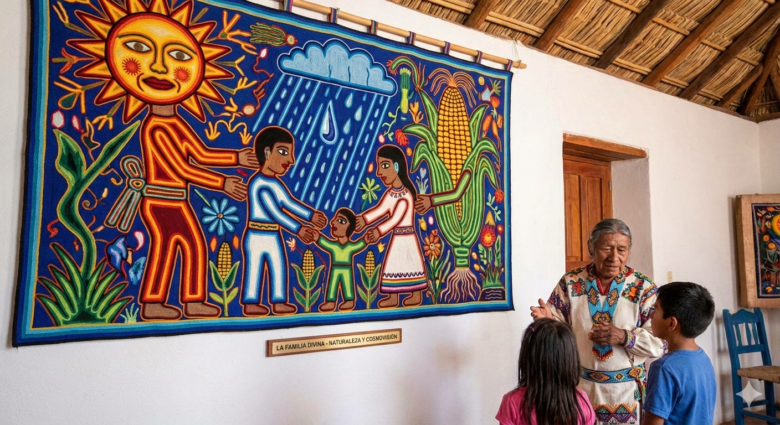
In order to understand the Wixaritari, one must first understand their cosmovision—a term that goes beyond “worldview” to encompass their entire philosophical, spiritual, and ecological understanding of the universe. They perceive reality as a vast, luminous, and “super interrelated web,” where every thread is connected to every other. In this web, pulling on one thread—whether it is a thought, an action, or a natural event—sends vibrations through the whole.

This is not an abstract philosophy but a practical guide to living. For example, they see a direct, tangible relationship between the Sun (Tau), the rain (Nakawe), the seeds (Otwanaka), and the community’s work, food, and joy. A successful harvest is not just the result of agricultural skill, but the culmination of a harmonious relationship with these spiritual forces. Conversely, they interpret concepts like winter, cold, or drought not as punishments, but as necessary periods of “austerity, reflection, singing, dancing, and waiting.” These are times to turn inward, to strengthen community bonds through ceremony, and to trust in the cycles of nature.
This holistic perspective fosters a profound ethic of respect and reciprocity. One does not take from nature without giving back; one does not act without considering the impact on the entire web.